 VOICES for Inclusion
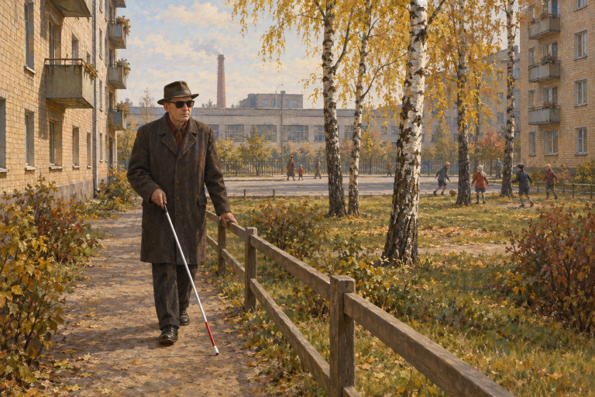 This is an AI-generated illustration inspired by descriptions of the Kaunas district. Not a historical photograph.
What does independence mean when you can move freely through your neighbourhood, but struggle to travel beyond it?
That question is at the heart of our new #EPALE blog, The City Within the City: Blind Districts of Soviet Lithuania. It explores the places where blind people lived, worked and built community during the Soviet era—and the boundaries that shaped their independence.
Two timelines offer a glimpse of how that story began and where it led.
From willow baskets to homes
The roots go further back than the apartment blocks. In Vilnius, the story starts with blind basket-makers in 1929. A couple of them were already weaving baskets on Antakalnio Street. Eight years later, the Society for the Care of the Blind got a 20-hectare farm at Baltadvaris where it planted willows to supply them. A workshop and shop followed in 1940; then came the first residential building for blind people in 1961 and a workers’ dormitory with 203 rooms in 1965.
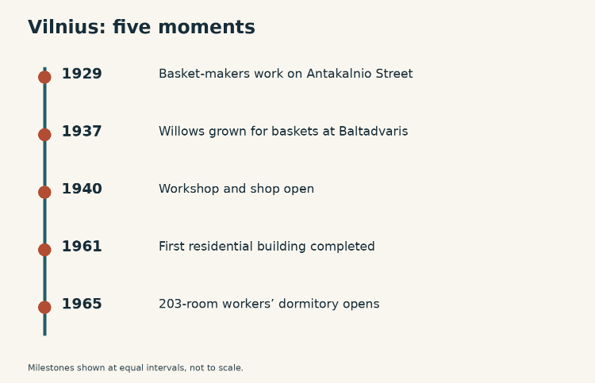
A new production building followed in 1964, and an administrative building opened in 1975.
From Braille to the library
The second timeline follows another kind of access: access to reading. In 1928, the first handwritten books in Lithuanian Braille appeared. The first Lithuanian audiobook arrived at the end of 1962. In 1966, libraries that had grown beside workplaces came together as a Central Library in Vilnius—a step on the road to today’s Lithuanian Audiosensory Library.
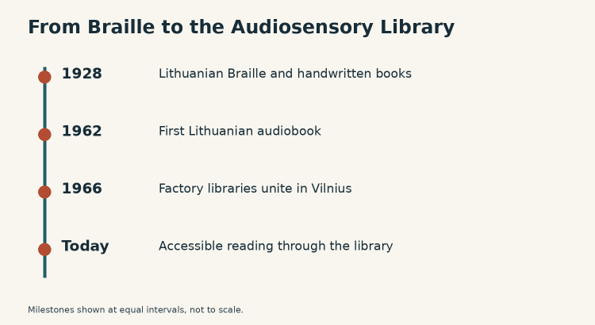
These timelines mark turning points, but they cannot show what it felt like to live between the freedom of a familiar district and the barriers beyond it. Was it autonomy if that freedom became harder to exercise outside the neighbourhood?
Read the full EPALE blog here to discover the people and choices behind the dates.
In the next chapter, we will take readers inside the Lithuanian Audiosensory Library in Vilnius and look more closely at the accessibility features we encountered during our visit organized in occasion of the VOICES_EU TPM in Vilnius. Open House Vilnius has described the renovated building as “probably the most accessible building in the country.” What does that look—and feel—like in practice? Stay tuned to find it out!
Comments are closed, but trackbacks and pingbacks are open.