 VOICES for Inclusion
In our last story, “The City Within the City,” we walked through the blind districts of Soviet Lithuania. They were known for their accessibility. Courtyards had walking paths and low fences you could follow with a cane, and a few intersections had beeping traffic lights. Under a busy Kaunas intersection ran an underground passage that blind people had paid for themselves. Blind people had something many people with disabilities in the Soviet Union never had: a job in the factory across the street and a key to their own flat. At a time when officials claimed there were “no invalids in the USSR,” that was real good fortune.
But that good fortune had walls. Their work was kept apart from everyone else’s, and so were their homes, services and accessibility, all within the walls of the blind district. The district kept its residents safe, and it also kept them on the margins, out of sight of the rest of the city.
So when we walked towards the Lithuanian Audiosensory Library in Vilnius, one question stayed with us. What happens when accessibility leaves the walls of a district and becomes part of a public building, open to everyone?
The library has been called the most accessible building in Lithuania. That is a big promise, and we wanted to see for ourselves. We also took a camera, because a picture says a thousand words, but only if it speaks to everyone. Under each photo we explain what it shows and why it matters, because seeing a feature isn’t the same as understanding it. Each photo also has alternative text, a short description of what the image shows. Sighted readers don’t see it, but screen reader programs pick it up and read it aloud, so blind and partially sighted readers can also know what is in the picture.
The way in
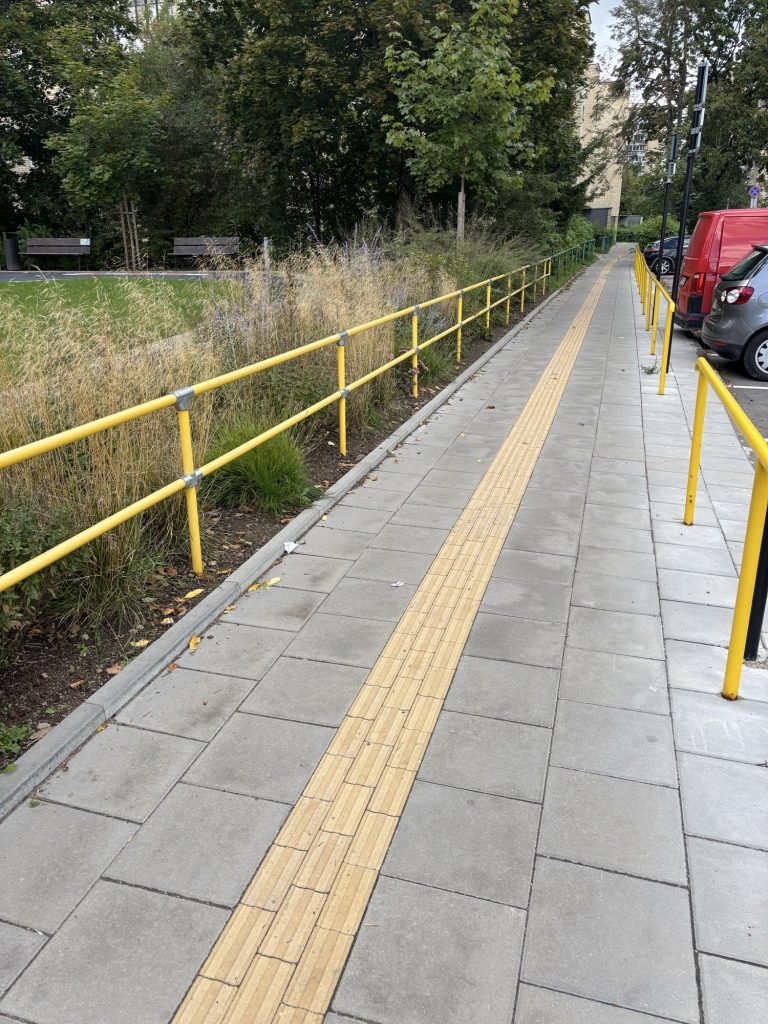
Our visit started before we reached the door. A yellow line runs down the middle of the grey path. Some people think it is there for rolling suitcases or prams, a smooth lane to pull your luggage along. It isn’t. It is a raised tactile strip, and for a blind person it works like a hand gently pointing the way: “Follow me, the library is this way.” No one has to come out to meet you, and you don’t have to ask a stranger for directions.
The bright yellow railings on both sides have a story of their own. In our last story, we heard that blind residents of the districts found their way by following low fences and hedges with a hand or a cane, even before white canes became common. You walked along them and they led you home, to the factory, to the shop. Here, that old idea has become a modern railing, painted bright yellow so it can also be seen. On the slope it helps a grandmother coming back from the market, someone recovering from knee surgery, or someone who suddenly feels dizzy. Some people with low vision can see the bright yellow from far away, so they always know where the path ends and the grass begins.
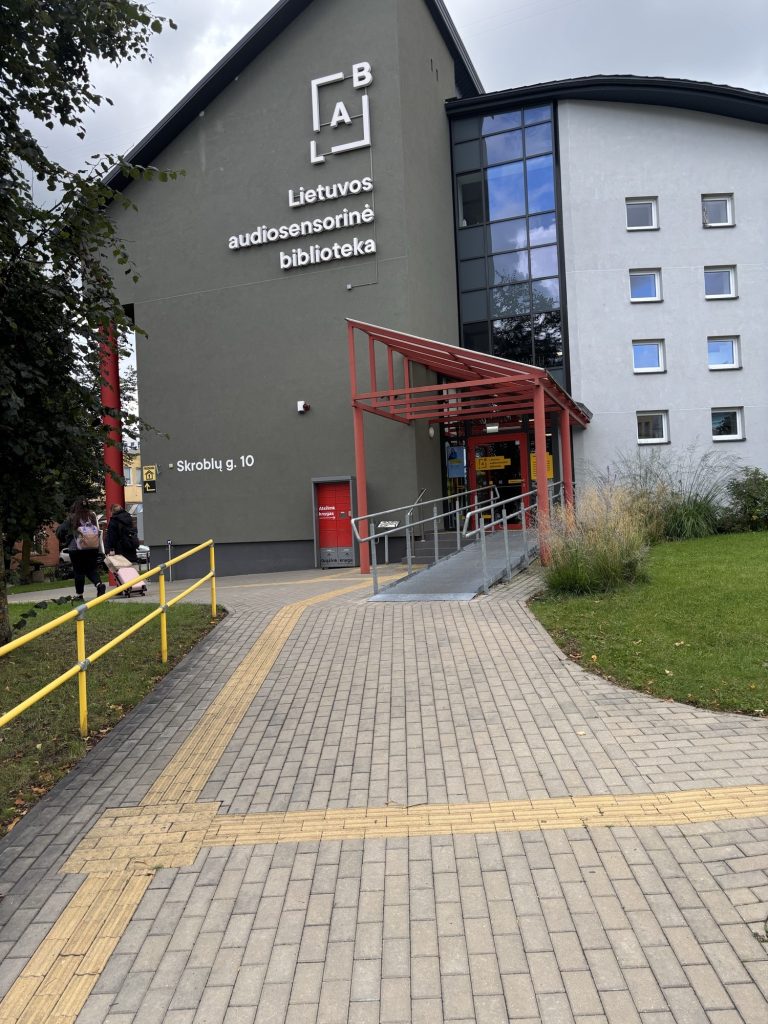
Then the building itself appears. The name is written in large white letters on a dark grey wall, readable even from the street. Under the red canopy the entrance is easy to spot, and you can wait there out of the rain while you find the handle.
And there is a ramp. Instead of steps you would have to “manage somehow,” a gentle slope leads to the door, with railings on both sides. While we were standing there, it struck us how many different people use it: a wheelchair user, a father with a pram, a woman pulling a heavy suitcase, an older man with a walker, a courier with a trolley full of parcels. The ramp was built “for people with disabilities,” and it serves everyone.
First steps inside
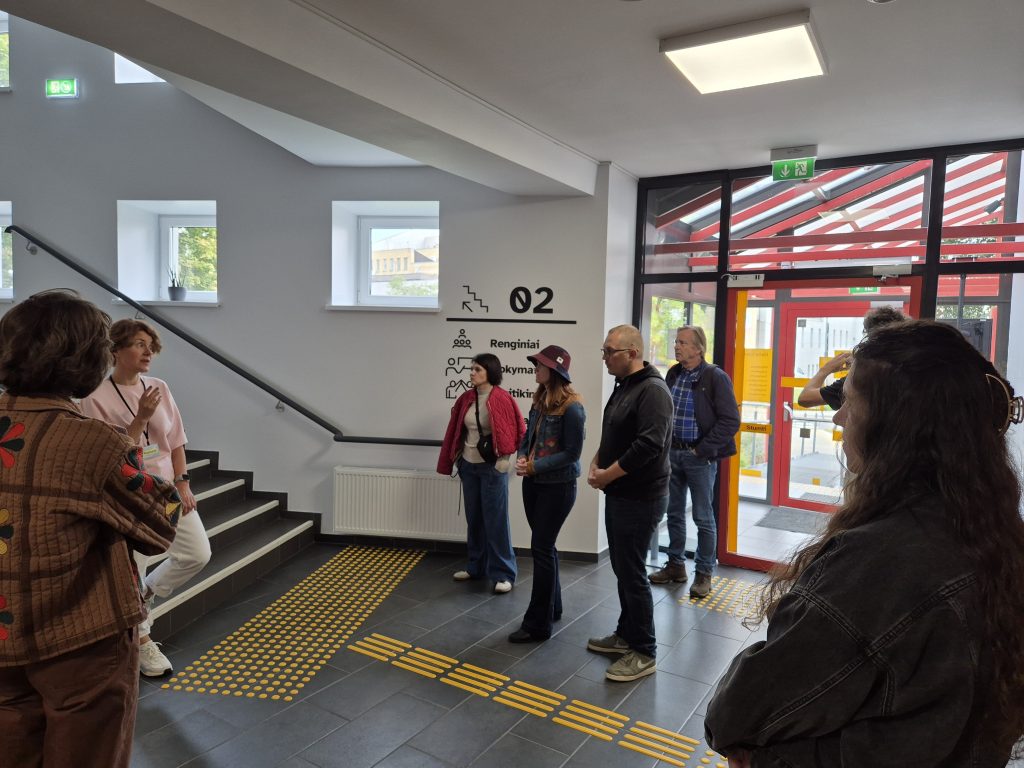
Inside the hall, the yellow lines continue across the floor. At the foot of the stairs they turn into a field of small raised dots. If the stripes say “walk on,” the dots say “stop, something is changing here.” For a blind person, this is the difference between a confident step and a fall.
You may notice something that is missing: there is no Braille or large raised text on the walls of the hall. That is not an oversight. A blind visitor here isn’t feeling along the walls. They follow the tactile paths on the floor, which lead to the reception desk, the stairs and the railings. Signs on the walls would only draw them away from the path they are meant to follow. Sometimes good accessibility means knowing what to leave out.
Each step has a light edge on a dark surface, so you can see exactly where it ends. This matters for people with low vision. It also matters for older people, for someone carrying a box that blocks their view, and for all of us on a tired evening when we misjudge a step. The handrail runs along the whole staircase and continues past the last step, because that is exactly where your hand looks for support.
On the wall there is a large “02” and a few simple pictograms: stairs, events, learning, meetings. You don’t need to speak Lithuanian or read well to understand where to go. A child, a tourist or a person with an intellectual disability can all follow the same signs.
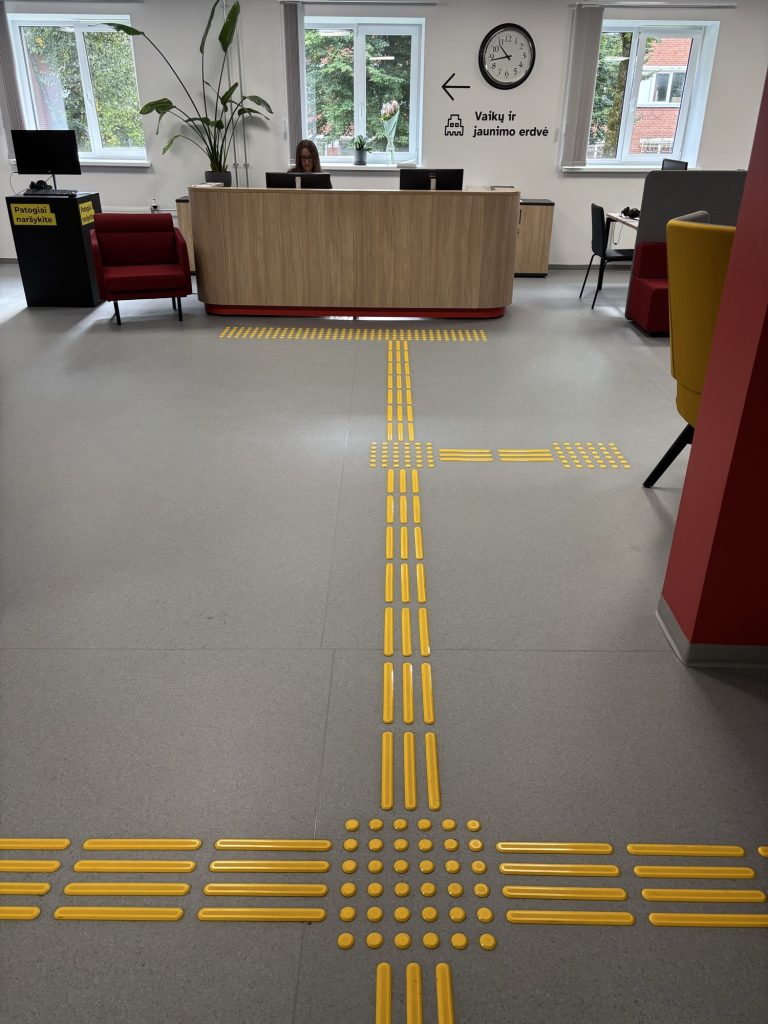
From the entrance, the tactile path leads straight to the reception desk, the first place a newcomer needs. Where the paths cross there is a small square of dots. Think of it as a crossroads you can feel with your feet, where you stop and choose a direction.
The desk is low and there is open space in front of it, so a wheelchair user can approach it face to face, not from below.
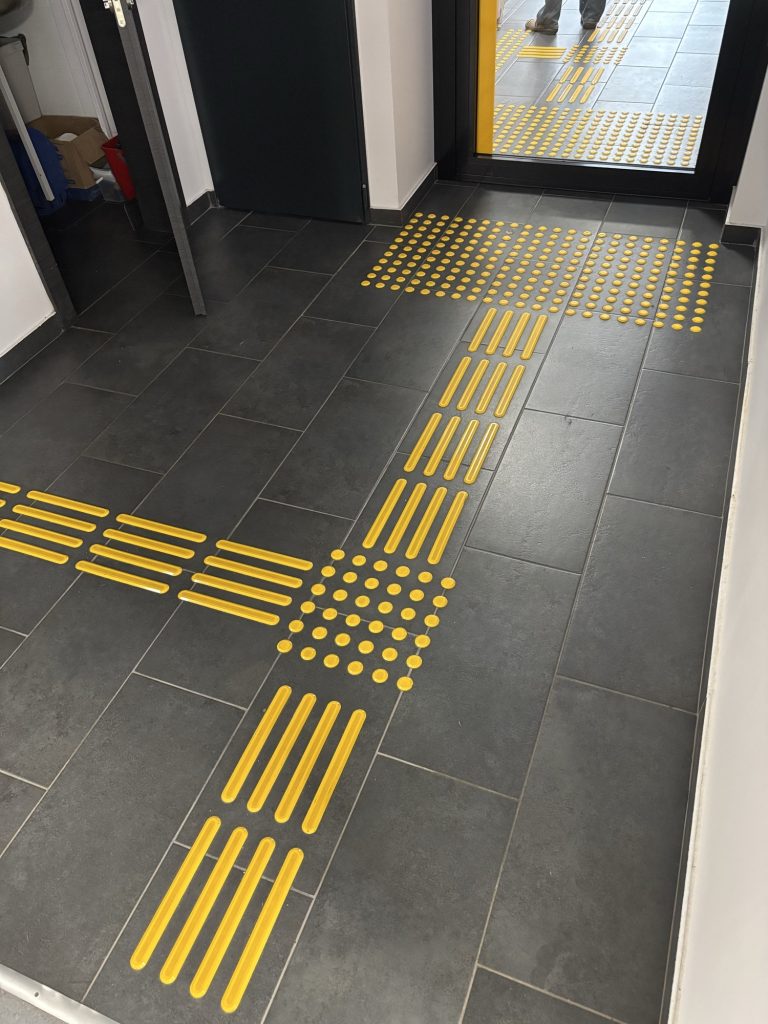
At this point, one of us asked: “So what exactly is the difference between these yellow things?” This photo is the answer. Long ribs mean “walk in this direction.” Dots mean “stop, there is a crossing, a door or a change of level.” A large field of dots in front of a door warns that the door is right there. It is a whole language written on the floor, and once learned, a blind person can walk from the street to the reception desk on their own.
Finding your way
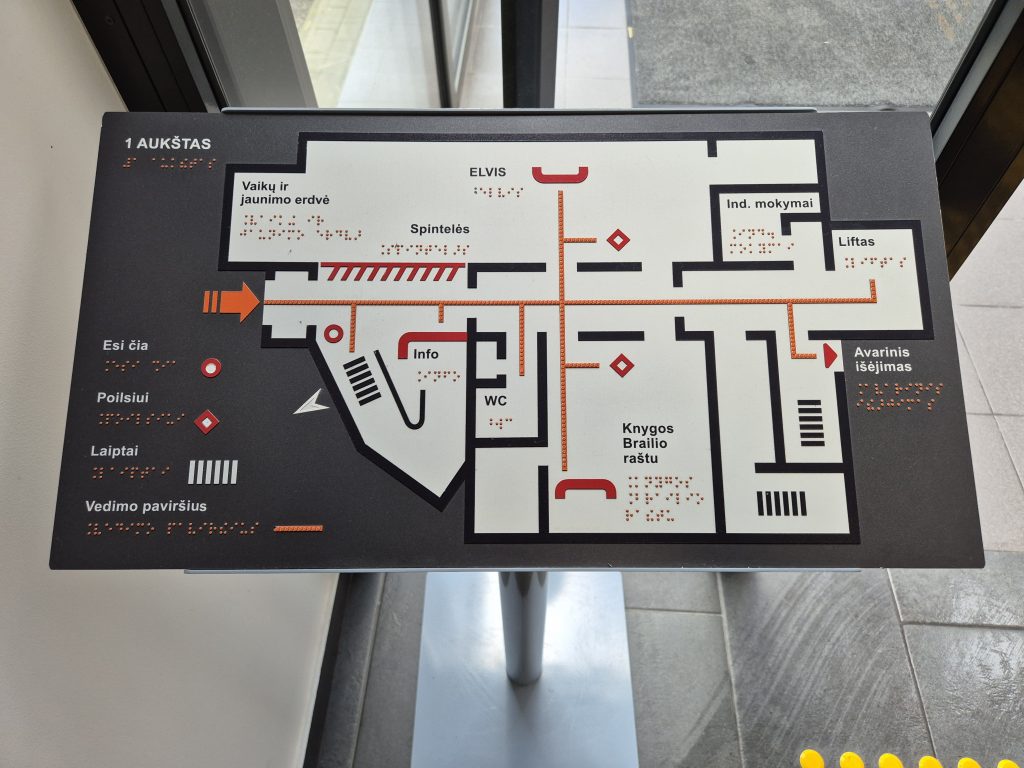
This was the moment many of us fell silent. It is a tacktile map of the whole floor that you can read with your fingers. Every label is written in both print and Braille. Look closely and you’ll see a detail that matters: the walls are solid black lines, while the paths are orange lines made of small dots. Your fingers can tell straight away whether they are touching a wall or a route you can walk along. If both were marked the same way, the map would confuse more than it helps.
“Esi čia” (“You are here”) is a small raised red circle. A red diamond marks places to rest. That matters to an older person who needs to sit down, someone with a chronic illness, or autistic people who need a quiet corner to recharge.
The map stands at an angle at waist height, so a wheelchair user can read it, a child can reach it, and a tall adult doesn’t have to bend over. One object tells the same story to people who see and to people who don’t.
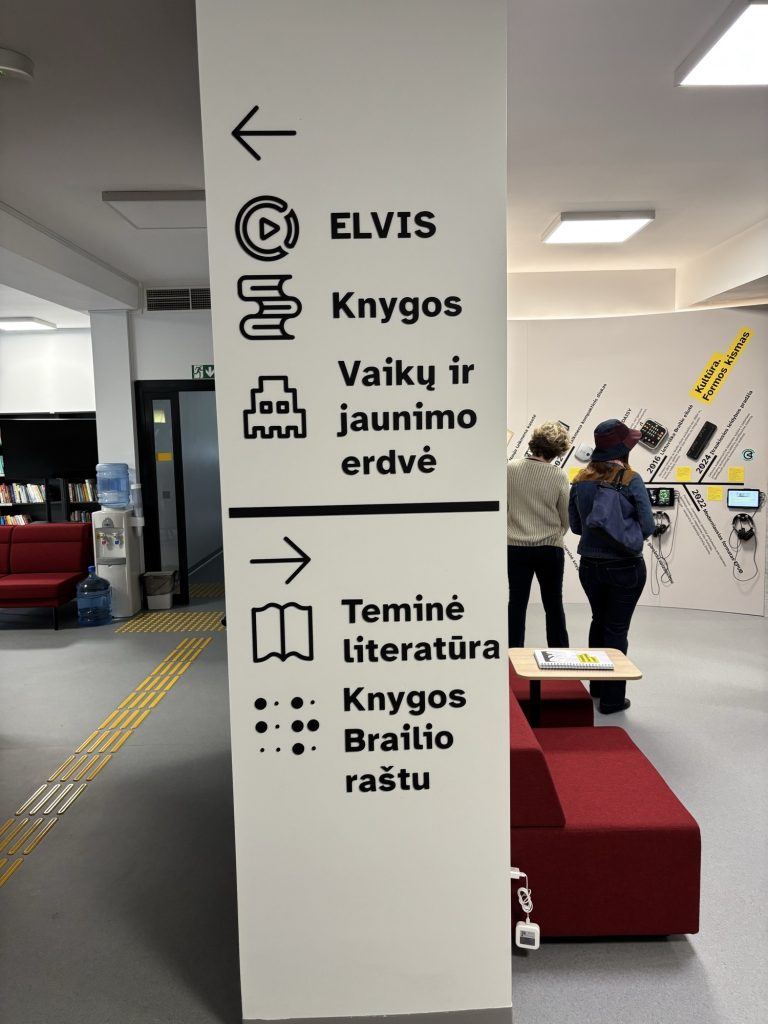
The signs are black on white, as clear as they can be. Every word has a picture next to it, and the six dots of the Braille cell mark the way to the Braille books. The letters are big and plain, with no decorative fonts. Good signage like this isn’t just “for the blind.” It is for anyone who is in a hurry, lost, tired, or simply new.
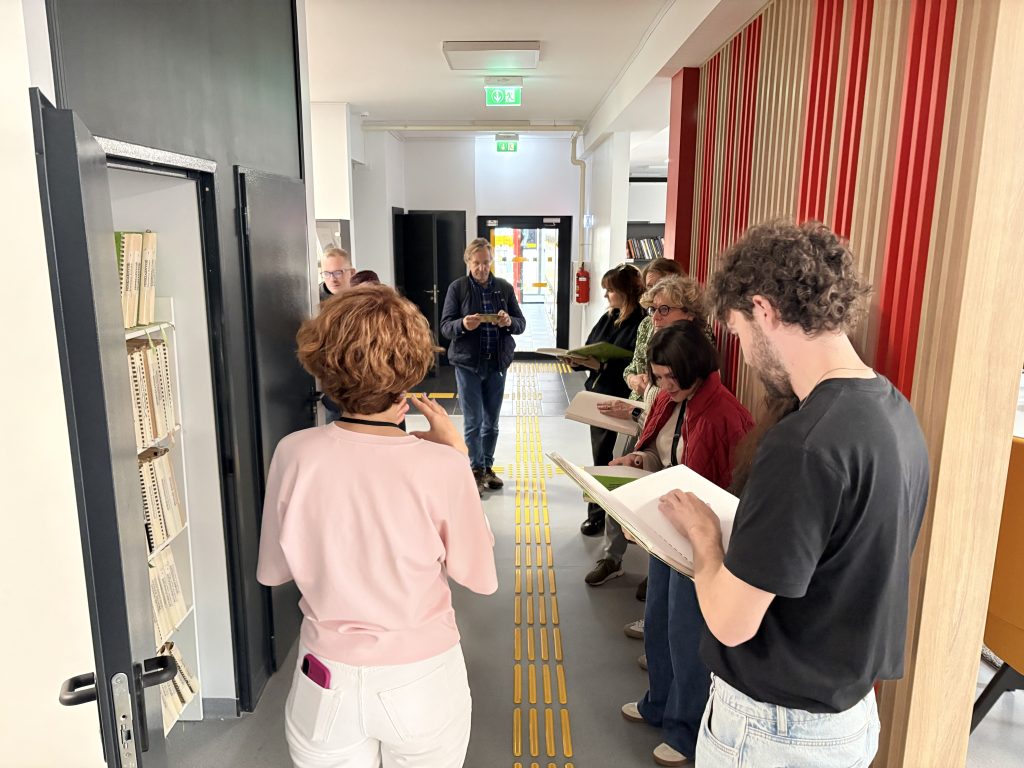
In the corridor, the yellow path leads us on. On a shelf next to it are thick spiral-bound books: Braille editions, within easy reach. The corridor is wide, clear and free of obstacles. That is not luxury. It is simply room for a wheelchair, a pram, or two people walking side by side while one guides the other.
Doors that speak
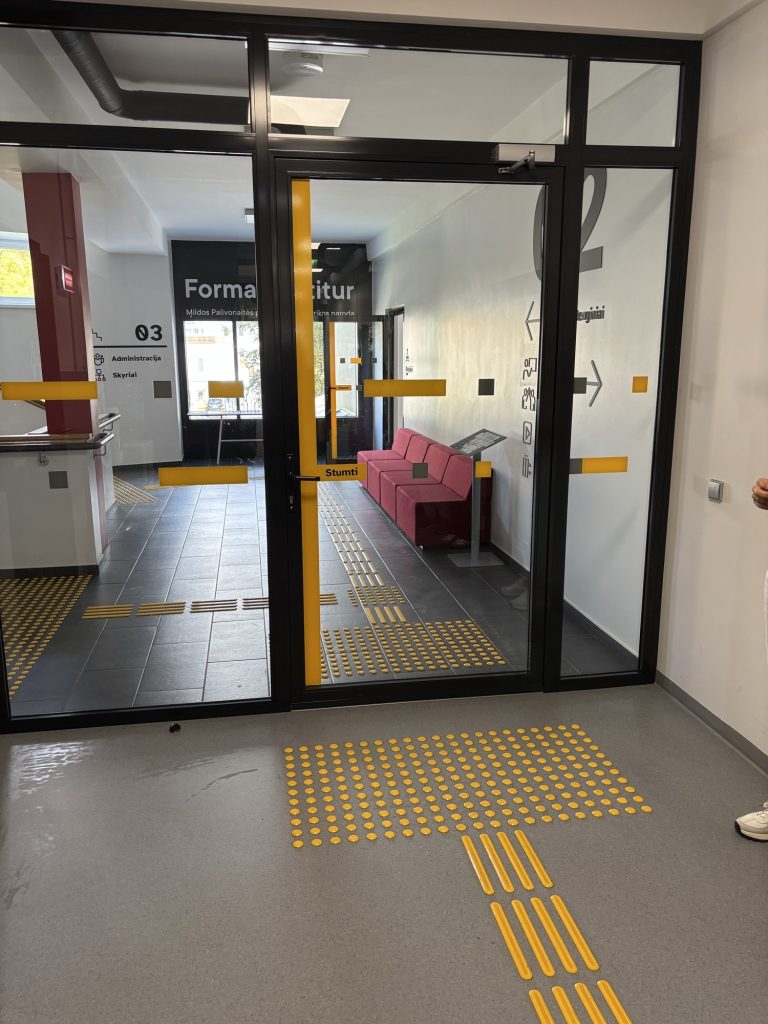
Glass doors are beautiful, and they are treacherous. Visually impaired people bump into them, but so do plenty of fully sighted people: someone looking at a phone, someone deep in conversation, a child running ahead. Many of us have done it at least once and laughed it off, rubbing our forehead. Here the glass has yellow stripes and dark squares at two heights, so both a standing adult and a child or wheelchair user can see them. The yellow edge shows where the door opens, the yellow “Stumti” label (“Push”) says how to open it, and a field of dots on the floor tells a blind person that a door is ahead.
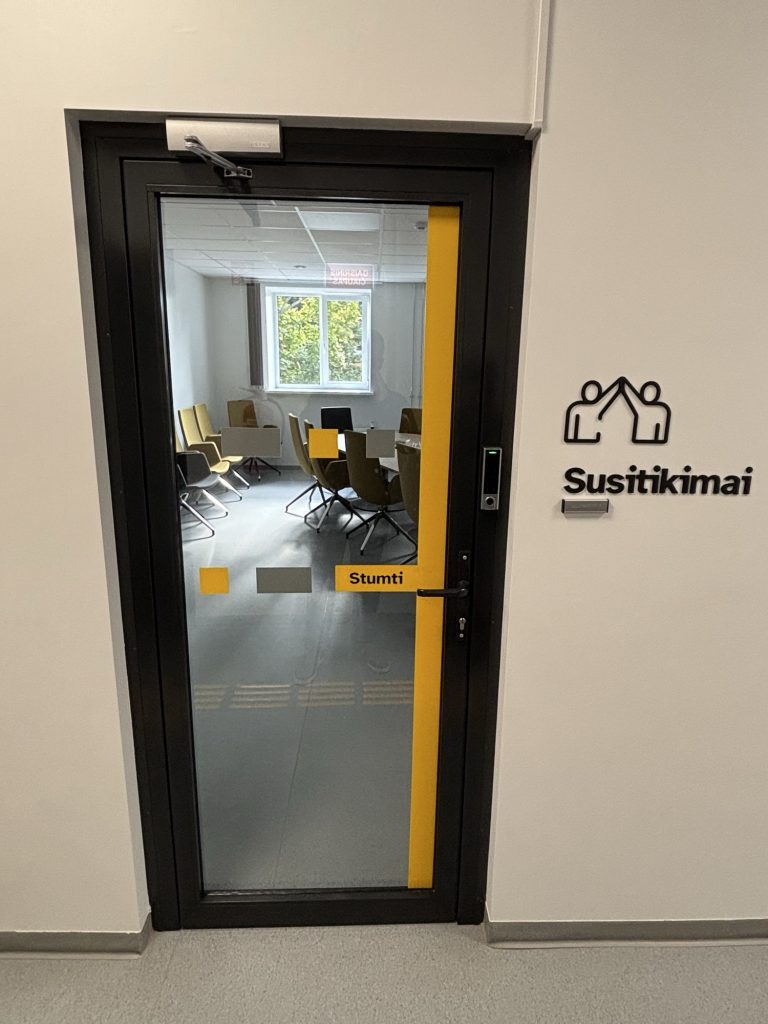
The room sign is not just printed on the wall. The letters and the pictogram are raised, so you can trace them with your fingers. The sign is at about eye level, next to the handle, exactly where a hand will look for it. The door has a lever handle. You can open it with an elbow when your arms are full, with a closed fist when your fingers hurt, or while holding a phone or a child’s hand. An automatic closer makes it light to move.
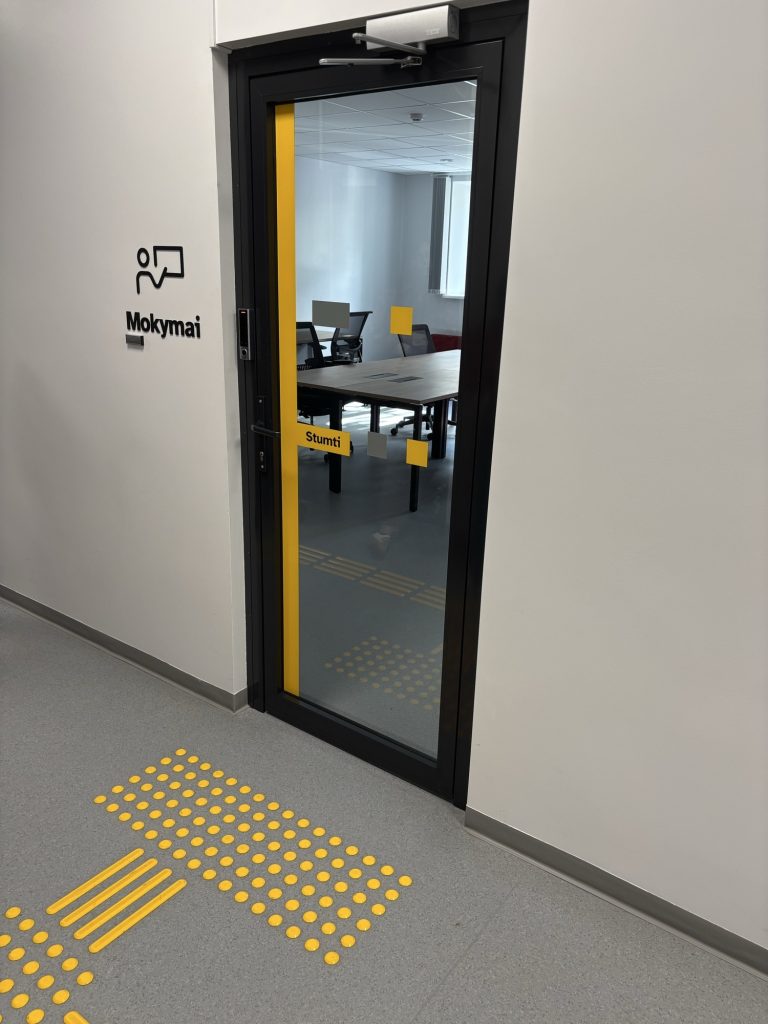
The training room follows the same system: a pictogram with a word, a yellow edge, and a field of dots right in front of the door. Once you learn the system, you can rely on it throughout the building. Consistency is accessibility too.
A museum you can touch and hear
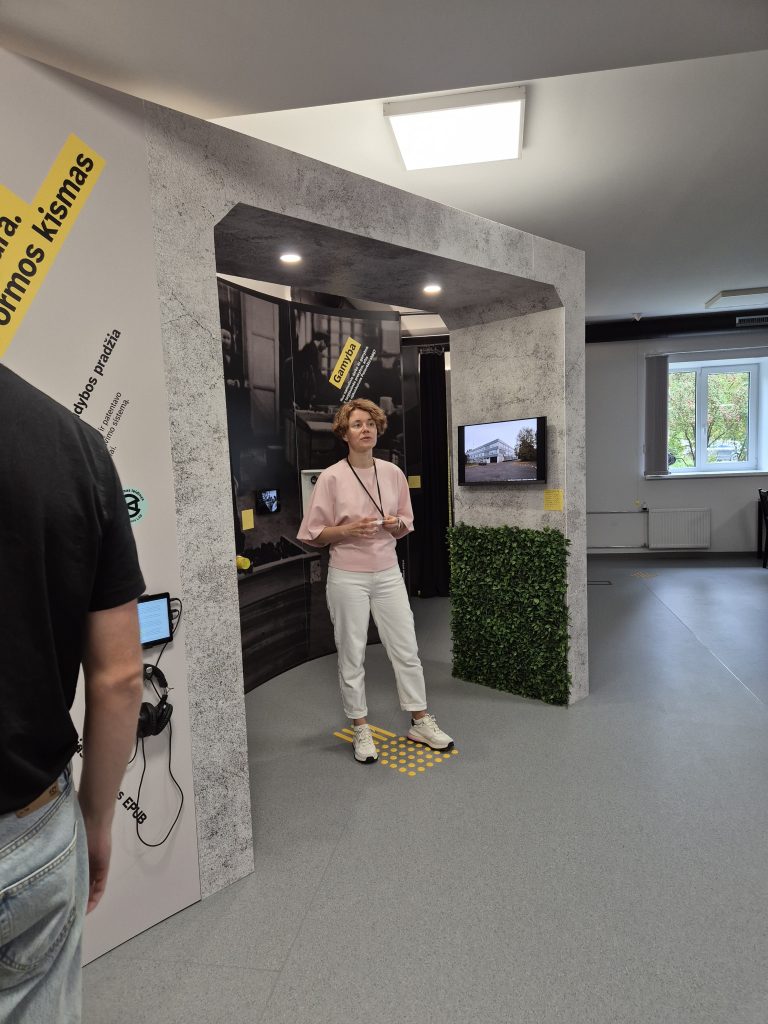
In the exhibition, our guide stood on a small square of yellow dots. For a blind visitor, that square says: “Stop here, there is something to explore.” Headphones and a tablet next to it tell the story in sound, which helps people who are blind, people with dyslexia, and anyone who simply prefers to listen. The walls have texture you can touch, from rough concrete to a wall of green leaves. This is what “multisensory” means: you don’t just look at the library, you experience it with different senses.
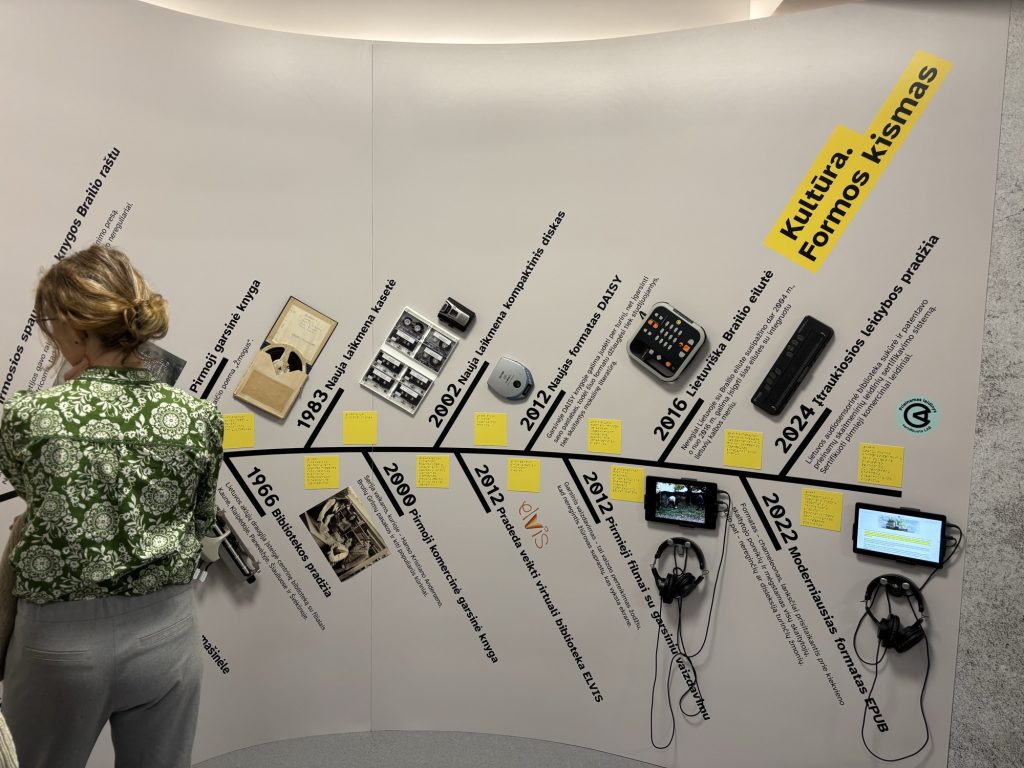
The timeline links back to our previous story: from the first Braille books and the 1962 audiobook “Žmogus” (“The Man”) to the devices of today. The real objects hang on the wall: an old tape recorder, cassettes, DAISY players, a Braille display. Visitors are allowed to touch them. Next to each year is a small yellow square with Braille, so blind visitors can read the history of their own reading with their own hands. Today the library offers most of its accessible books in EPUB format, which can be read with a screen reader, enlarged, or shown in high contrast. It is the latest step on the same road.
The room no one photographs
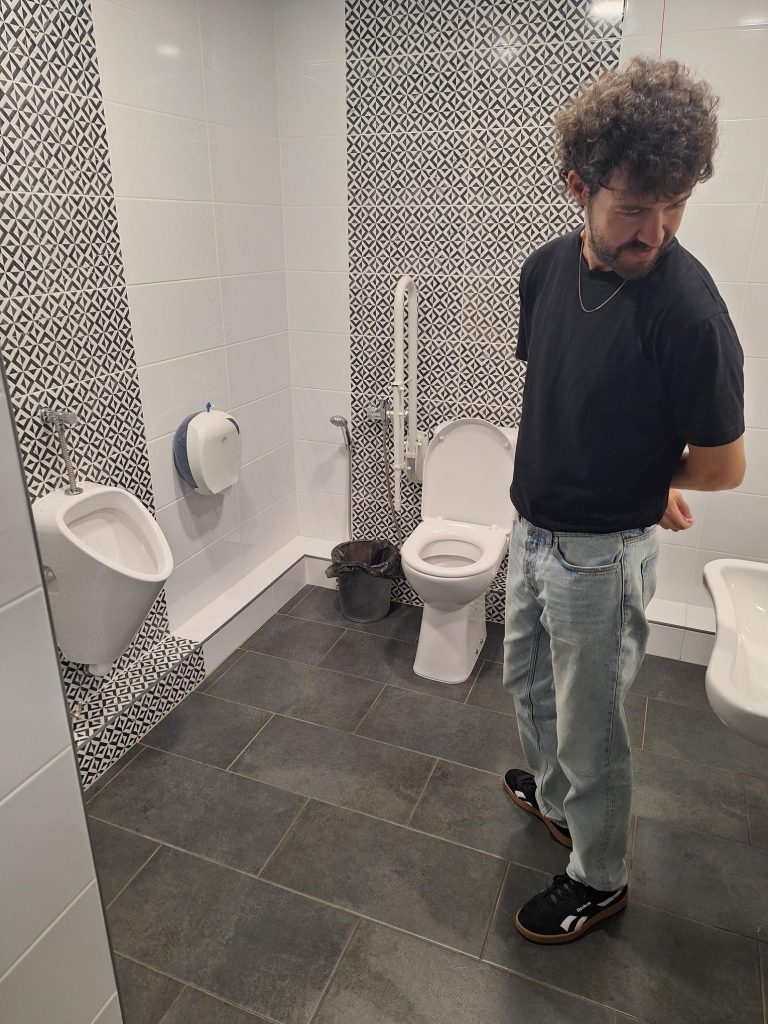
Yes, we photographed the toilet, because it is often where accessibility quietly fails. Here there is a grab bar next to the toilet, a hand shower, and enough space to turn a wheelchair. Contrasting black-and-white tiles show where each fixture is. It is not glamorous, but it is the difference between staying in a building for a whole day and having to go home after an hour.
A place to rest
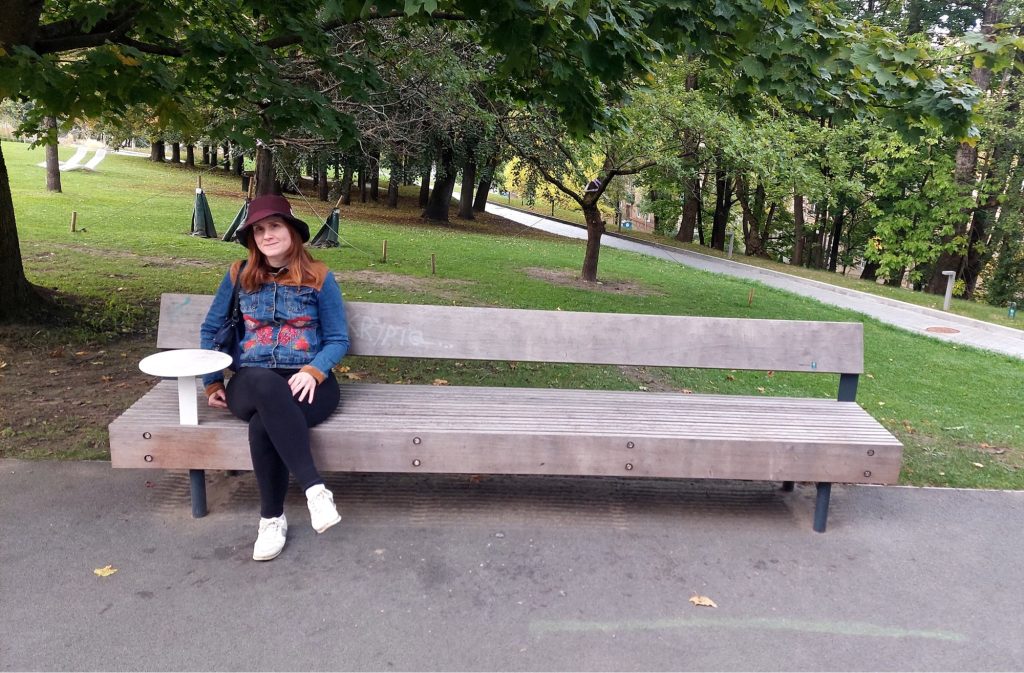
Remember “Pletkų” Alley, the little Gossip Alley in the Kaunas blind district, where neighbours sat and talked? Near the library we found its modern cousin: a long wooden bench with a small round table built into one end. The backrest and the solid end help you sit down and stand up again. That is a real help to older people, pregnant women, or anyone with sore knees. You can put down a cup, a book or a phone on the little table without bending to the ground. And there is free space next to the bench, so a friend in a wheelchair can sit beside you, not in front of you. A bench seems like the simplest thing in the world, until you are the one who can’t walk another hundred metres without resting. And a good bench, like a good alley, is where people stop, meet and talk.
What the pictures told us
We came to check whether this really is the most accessible building in Lithuania. We left with a different thought. Every feature we photographed was designed with a particular person in mind, and every one ended up helping someone else as well. The ramp helps the parent with a pram and the courier with parcels. The handrail helps the grandmother. The clear signs help the tourist. The lever handle helps someone whose hands are full of shopping. The bench helps the person who simply needs to rest.
We like to think of disability as something that happens to “others.” But our bodies change all the time. We get older, we break a leg skiing, we push a pram, we lose some sight, we have a bad day. Change is inevitable, and none of us knows what tomorrow brings. It might not be someday. It might be the next second. Once you start thinking this way, a yellow line on the floor is no longer “for the blind.” It is for all of us.
Now that you have looked through a different pair of glasses, try them on in the streets of Vilnius, or any city near you. You’ll start noticing the yellow ribs and dots at pedestrian crossings, on railway platforms, at bus stops and in front of public buildings. The tactile paths that once existed only inside the blind district now run through the whole city. In a way, the blind district has come out from behind its walls and become part of the city. That is exactly what the disability community has been working for all along: not a separate world built specially for us, but a shared world built with all of us in mind.
Comments are closed, but trackbacks and pingbacks are open.